
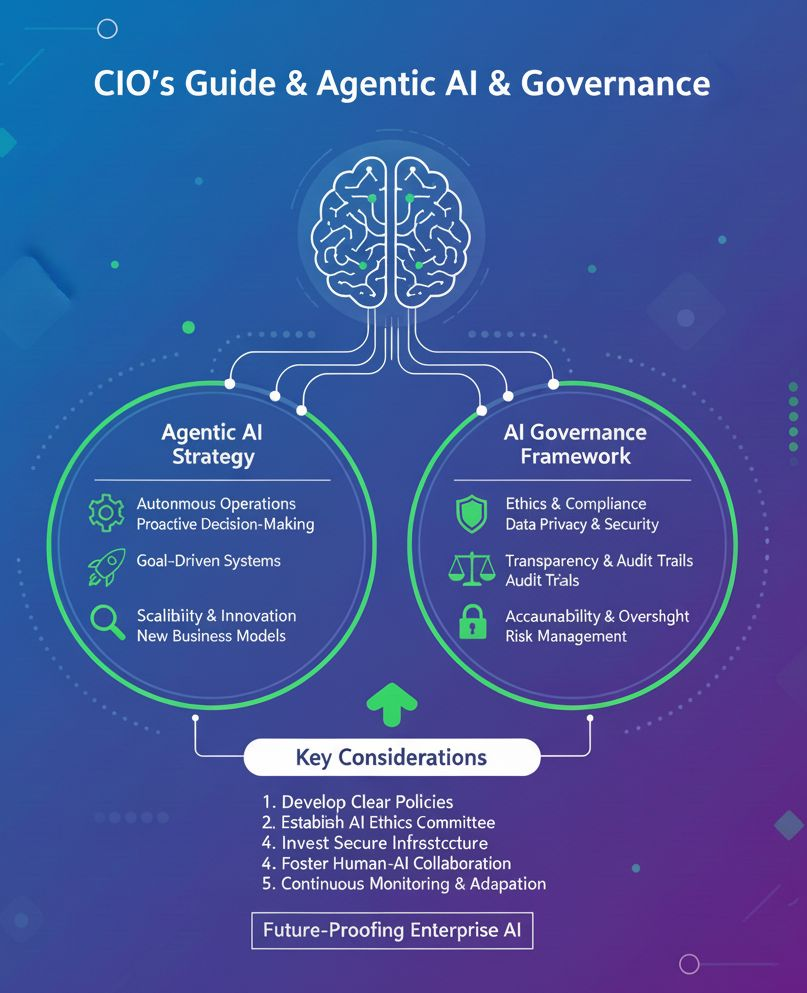
The rapid evolution of Artificial Intelligence presents both unprecedented opportunities and significant challenges for enterprise leaders. For the Chief Information Officer (CIO), understanding and strategically aligning the deployment of Agentic AI with a robust AI governance framework is no longer optional – it’s imperative. Our accompanying graphic, “CIO’s Guide & Agentic AI & Governance,” offers a visual roadmap for this critical journey, highlighting the symbiotic relationship between these two pillars of future-proofing enterprise AI.
At its core, Agentic AI Strategy represents the proactive adoption of AI systems capable of autonomous operations, proactive decision-making, and goal-driven execution. These are not merely tools; they are intelligent agents designed to extend human capabilities, drive innovation, and unlock new business models. Imagine AI systems that can independently manage supply chains, optimize resource allocation, or even identify and capitalize on emerging market trends without constant human intervention.
Key considerations for a CIO when developing an Agentic AI strategy include:
- Autonomous Operations: Moving beyond predictive analytics to systems that can initiate actions based on their insights. This requires a shift in mindset from simply observing data to empowering AI to act on it.
- Proactive Decision-Making: Agentic AI can anticipate needs and make decisions that traditionally required human judgment, leading to increased efficiency and responsiveness.
- Goal-Driven Systems: Designing AI with clear objectives and performance metrics ensures alignment with business outcomes. This moves AI from a general-purpose tool to a strategic asset.
- Scalability & Innovation: Agentic AI, by its nature, can scale operations and explore new possibilities far beyond human capacity, fostering innovation and the development of entirely new business models.
However, the power of Agentic AI brings with it an equally significant need for AI Governance. Without a comprehensive governance framework, the autonomy and proactive nature of Agentic AI could introduce unacceptable risks, ranging from ethical dilemmas and data privacy breaches to regulatory non-compliance and reputational damage. AI governance is the bedrock upon which trust, accountability, and responsible innovation are built.
A robust AI Governance Framework for a CIO should encompass:
- Ethics & Compliance: Establishing clear ethical guidelines and ensuring adherence to relevant regulations (e.g., GDPR, CCPA) is paramount. This involves defining acceptable AI behaviors and outcomes.
- Data Privacy & Security: Agentic AI systems often process vast amounts of sensitive data. Robust security measures and strict data privacy protocols are essential to protect this information and maintain user trust.
- Transparency & Audit Trails: The “black box” nature of some AI systems is a significant concern. Governance must mandate explainability, ensuring that decisions made by AI can be understood, justified, and audited. This includes comprehensive logging and record-keeping of AI actions and decisions.
- Accountability & Oversight: Defining clear lines of responsibility for AI system performance, failures, and ethical breaches is crucial. Human oversight mechanisms, including kill switches and intervention points, must be integrated.
- Risk Management: Proactively identifying, assessing, and mitigating potential risks associated with Agentic AI, including biases, unintended consequences, and malicious use.
The Indispensable Alignment: How Agentic AI and AI Governance Are Related
The relationship between Agentic AI strategy and AI governance is not merely complementary; it is interdependent. You cannot effectively pursue one without the other. Implementing Agentic AI without a strong governance framework is akin to building a powerful self-driving car without brakes or a steering wheel – it’s a recipe for disaster. Conversely, an overly restrictive governance framework can stifle the very innovation that Agentic AI promises, preventing organizations from realizing its full potential.
For the CIO, the strategic imperative lies in finding the optimal balance. This means embedding governance considerations from the very inception of any Agentic AI project, not as an afterthought. It’s about designing “responsible by default” AI systems.
Key Strategic Considerations for the CIO:
- Develop Clear Policies: Establish organizational policies that define the ethical boundaries, acceptable use cases, and operational guidelines for Agentic AI.
- Establish an AI Ethics Committee: Form a cross-functional committee (comprising legal, ethics, technical, and business leaders) to review, guide, and oversee AI initiatives, especially those involving agentic capabilities.
- Invest in Secure Infrastructure: The infrastructure supporting Agentic AI must be resilient, secure, and capable of handling complex, real-time operations while protecting sensitive data.
- Foster Human-AI Collaboration: Recognize that Agentic AI is designed to augment, not replace, human intelligence. Develop strategies for effective human-AI teaming, where humans provide oversight, context, and ethical guidance, and AI handles complex, repetitive, or data-intensive tasks.
- Continuous Monitoring & Adaptation: AI systems are dynamic. Governance frameworks must be equally agile, allowing for continuous monitoring, evaluation, and adaptation as AI capabilities evolve and new risks emerge.
In conclusion, the journey into Agentic AI is one of transformative potential. For the CIO, leading this journey requires a dual focus: strategically leveraging the power of autonomous AI to drive business value, while simultaneously establishing a robust and adaptive governance framework that ensures ethical deployment, regulatory compliance, and sustained trust. By aligning Agentic AI strategy with comprehensive AI governance, CIOs can truly future-proof their enterprise and navigate the complexities of this new frontier with confidence and responsibility.